Showing posts with label latin. Show all posts

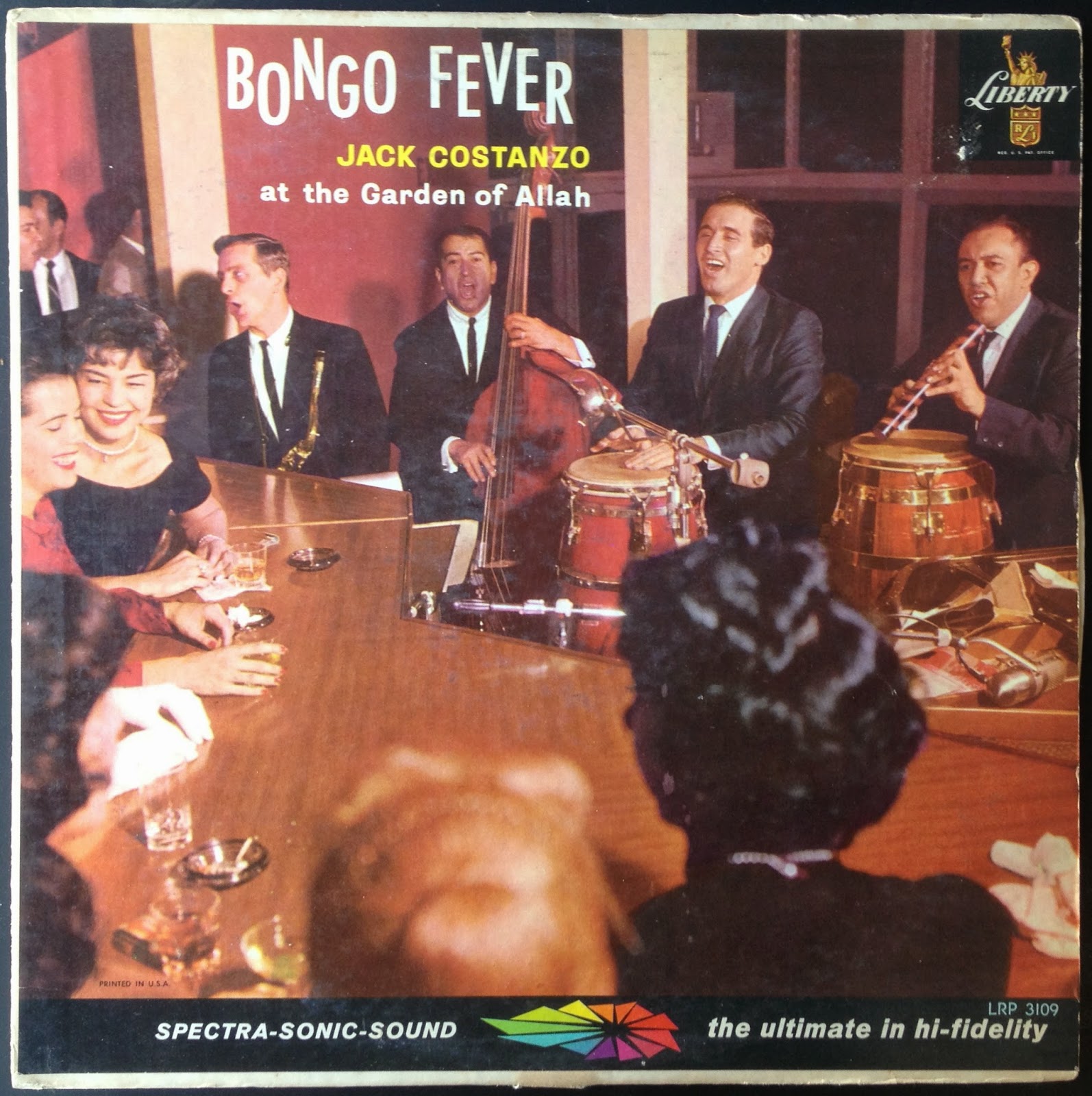
Jack Costanzo at the Garden of Allah - Bongo Fever (Afrocuban jazz, 1959)

(Liberty LRP 3109).

Here's a spicy version of "Quiere" by Jack Costanzo recorded live at the Garden of Allah, a famous place frequently visited by Hollywood intelligentsia from the late 20s.

Los Dementes - Descarga a la Ray (Venezuela, 1966)

(Prodanza - LP 1240).

First LP from Ray Perez with Los Dementes, playing in Caracas from the mid 60s. I found this Venezuelan version in Colombia. Los Dementes used the word "salsa" as a music style before it became widely used in New York, and this LP includes boogaloo, guaguanco, pachanga, and salsa. Despite the rough mix, "Descarga a la Ray" is totally crazy, also very innovative at this period comparing to famous local bands such as Billo and his Caracas Boys... 

Manolo Guardia - Negro en sol menor (Candomble inspired jazz from Uruguay, 1960s)

(Fermata 3F0128).


Candomble beleives and culture, originated from african voduns and musically based on drums, are widespread in Brazil, but also traveled south down to Uruguay, where exist also expressions of this religion.
Successful meeting of jazz and candomble rhythms is not so common, so I hope you enjoy this track from Manolo Guardia, uruguayan pianist both interested in jazz and tango, and who experimented unique afrolatinjazz fusion during the 60s.

Les Docteurs du Rythme - Haiti Goes Latin (Creole mambo, 60s)

(ANSONIA SALP 1538).

Michel Desgrottes (1923-1993) worked with Guy Durosier in Hotel Rivera orchestra in the 50s. This 60s LP is based on french popular themes brought back by producer Jean Huc and played in a haitian latin style. But Michel Desgrottes' own composition "Ce Pas Fot Moin" (meaning "it's not my fault") is an irresistible jazzy mambo sung in Creole.

Celina y Reutilio - A Santa Barbara (45rpm Puchito, 1950s)

(Puchito/Talia X013).

A cuban classic from Puchito records label, sung by duo Celina y Reutilio, the track "A Santa Barabara" is more famous under the name "Que viva Chango". 

Celina Gonzales and Reutilio Dominguez begun their duo in Santiago de Cuba, playing originally countryside music as Punto cubano (popular style based on poetic improvised verses, including clave and guiro, and played with several guitars using picking technique). Collaboration with Nico Saquito led them to La Habana and then New York.
Santa Barabara is the catholic saint used to represent Chango, the fire divinity from the Yorubas, probably due to the red color and the sword they have in common. African salves brought their culture and believes in the Caribbean, but Orishas devotion was prohibited by colonists, which led to a syncretic alternative : almost each voodoo divinity has a correspondence with a catholic figure, allowing the believers to practice their religion, fitting with colonial catholic rule. In parallel, secret societies were created, like AbakuĆ”, in order to preserve and perpetuate african religions and traditions.
Therefore, presence of Orishas culture  in cuban recordings was not very common before the 60s. This song praising Santa Barbara (lyrics deal with Orishas but music is not based on traditional voodoo rhythms), it represents an interesting expression of the veiled devotion for afrocuban gods (which remains popular up to now).

Alejo Duran sings and tells his life (Colombian archives, 1986)


Alejo Duran is a legend in Colombia, as king of the most popular style: Vallenato. This day of 1986, going out the recording studio where he comes back to events of his life, Alejo Duran said to the interviewer: "I would like this reel to be kept up to the day I die... supposing this day ever happens". He died three years later and this LP was released in 1989.

Marimba rhythms from Colombia Pacifico


Marimba traveled from Africa (balafon) to Central America and the Caribbean several centuries ago. This percussive and melodic instrument had time to spread and can be found along the Pacific shore from Mexico to Ecuador, where it became an integral part of local folklore (and even national pride in Guatemala).
I had opportunity discover how marimba is played in Central America, but influence of african rhythms is not as significative as in Colombia. In Chocó region, the main folkloric style is the currulao (dance and rhythm), where marimba transmits a unique deep swing. So just a post to share some rough recordings, which will probably sound familiar to you as these rhythms are still source of influence in some modern productions today (and still the base of actual folkloric music from the Pacific area). 

Conjunto Papaupa and a brief glimpse on afro-venezuelan culture

(Music With Soul 7").

Actual growing interest for "tropical" music provides a wide variety of projects and vinyl releases. Muzzicaltrips looked into a afro-venezuelan influenced project (Conjunto Papa Upa, from the Netherlands based label Musicwithsoul), a very good actual DJ friendly sound, loaded with interesting traditional elements. This was opportunity to exchange with the father of this project, Alex Figueira, a real music specialist on the (yet little documented) afro-venezuelan culture.

Lets  start with a synthetic 7 minutes historical introduction to afro-venezuelan culture:


Cuba VII Congreso de la Union Internacional de Arquitectos (1963)


In 1963, the 7th Congress of UIA (Union Internacional de Arquitectos) released a special LP for the event, presenting diversity of cuban music. 

Musical testimony of cuban government's activism in many cultural fields, impulsed from the early 60s, this congress organized in parallel a music festival (on cathedral's place, which inspired many designs), and released several LPs, including this compilation. I guess one motivation of the production was that every architect attending the congress could go back in his country with some sample of cuban music. The early 60s were a transition period for cuban musical scene, after decades of tremendous activity. Styles presented go here from cha cha cha, bolero and waltz (classy), to guaracha or rumba (more popular), but no cuban jazz is included.

Bola de Nieve - Chivo Que Rompe Tambo (Cuba, 1960)

(Sonotone SLP8).

Ignacio Jacinto Villa Fernandez (1911-1971), received his surname Bola de Nieve (Snowball) by cuban singer Rita Montaner. He's a really atypical singer and pianist in cuban musical scene, active from the 30s, then famous internationally, to the 60s he spent back in Cuba.

Alberto Beltran, El Negrito del Batey (Dominican singer in Cuba, Panart 1950s)

(Panart LP-2017).

Panart Records was a pre-revolution cuban record label (before 1959), and released a good number of amazing records. Here's Alberto Beltran, a dominican singer, joined by Conjunto Casino. 
Alberto Beltran (+1997) begun his musical career in "Republica de Santo Domingo" in the 40s, and fame allowed him to travel to CuraƧao, Puerto Rico, New York, Haiti, and then to push merengue style in Cuba, recording from 1954 with Sonora Matancera and Conjunto Casino.

MIX /// Tropical Roundtrip Selection (from Colombia to Africa)

(Muzzicaltrips TRT019).

A real tropical roundrip, beginning in colombia with classy 60s cumbia, guiro y guaracha, merecumbe, maracumba, currulao, afrocolombian...
A selection warmly advised to people still convinced that all latin music is more or less salsa... Actually we begin with few examples of the countless styles having emerged in Colombian regions, as merecumbe, being a blend of merengue+cumbia initially popularized in the 50s by Pacho Galan, and here played by Lucho Bermudez.

Pico Culture #04 - Soundsystems aesthetics (Baranquilla)


Above painted wood piece is an original decoration from the pico "El Solista", carefully conserved by a fanatical pico lover.
From the 70s each pico developed his own aesthetics through colorful paintings and decorations on the speakers and the control tower. This transmits a real identity to each pico, and can be inspired from pure psychedelic figures (El Dragon, El Cobra), or from personal experiences (for example, El Coreano was created by a colombian man who went to fight in Korea war), or from musical artists (El Pijuan), or from revolutionary figures (El Gran Che, El Gran Fidel). The visual identity personifies the pico, and usually transmits a message of power ("indestructible", "la potencia africana", "guerrillero de la salsa").


Carnaval in Santiago de Cuba (1960s)

(Le Chant du Monde, LDX 4250).

Carnavals tour stops for sure in Cuba, through the release of this LP by french label Le Chant du Monde. Liner notes from the cuban writer Alejo Carpentier remind the historical background of original african and Spanish influences blending in Santiago, the second city founded in Cuba.

Pedro Laza y sus Pelayeros - Fandango (and Porro from Colombia, 60s)

(Fuentes LP 0011).

This early LP recorded by Pedro Laza for Fuentes label consists of 2 kind of styles widely played in Colombia: Fandango and Porro. 
Fandango is originally an old spanish ternary rhythm, but being brought early to Colombia, it integrated local influences, african drums, brass bands (bandas papayeras), to become a successful style for record industry in the 50s.

Climaco Sarmiento - Bombo y Maracas (Colombia, 60s)

(Fuentes LP0061).

This heavy record is the second Cimaco Sarmiento released for Fuentes. It includes cumbia, gaita, porro, plena and also palenque, as is tagged the "Bombo y Maracas" hit. Hanging around in Baranquilla bars can reveal great record collections, and even in some small places, attention is paid to play the music with original vinyls...

Caribbean Rhythms from San Andres (Folklore, 1957)

(Folkways FW 8811).

San Andres is a caribbean island with english west indies influence. This is noticeable musically, but this island having being part of nicaraguan and now colombian territory, it also integrates latin culture and spanish language.